
Finding reliable Leather Goods suppliers is more complex than comparing catalog prices. Global buyers must examine material quality, production capacity, communication, and delivery performance. A polished website proves very little. Real confidence comes from samples, factory evidence, and consistent documentation.
Bernhard Roetzel, author and menswear expert, once wrote, “Leather is a material that improves with age.” This idea reflects both the appeal and responsibility of leather products. A well-made wallet should develop a natural patina, not crack after a few months. A travel bag should retain its shape under repeated use. These details separate skilled suppliers from ordinary trading companies.
Quality starts with the hide and continues through cutting, stitching, edge painting, hardware selection, and final inspection. Buyers should ask about tanning methods, restricted substances, traceability, and applicable product standards. Certifications can help, but they should be verified carefully. Documents may be incomplete. Samples may look better than bulk production. These risks are easy to underestimate.
Supplier selection also requires practical questions. Can the manufacturer support the required minimum order? Can it repeat the same color across different batches? Does it provide clear lead times during peak seasons? A factory visit, live production video, or independent inspection can reveal useful details.
No supplier is perfect. Even experienced buyers make wrong assumptions. Therefore, this guide compares leading Leather Goods suppliers through a balanced lens. It considers craftsmanship, customization, responsiveness, transparency, pricing, and long-term reliability. The strongest partner is not always the cheapest one. It is the supplier that can prove its promises consistently.
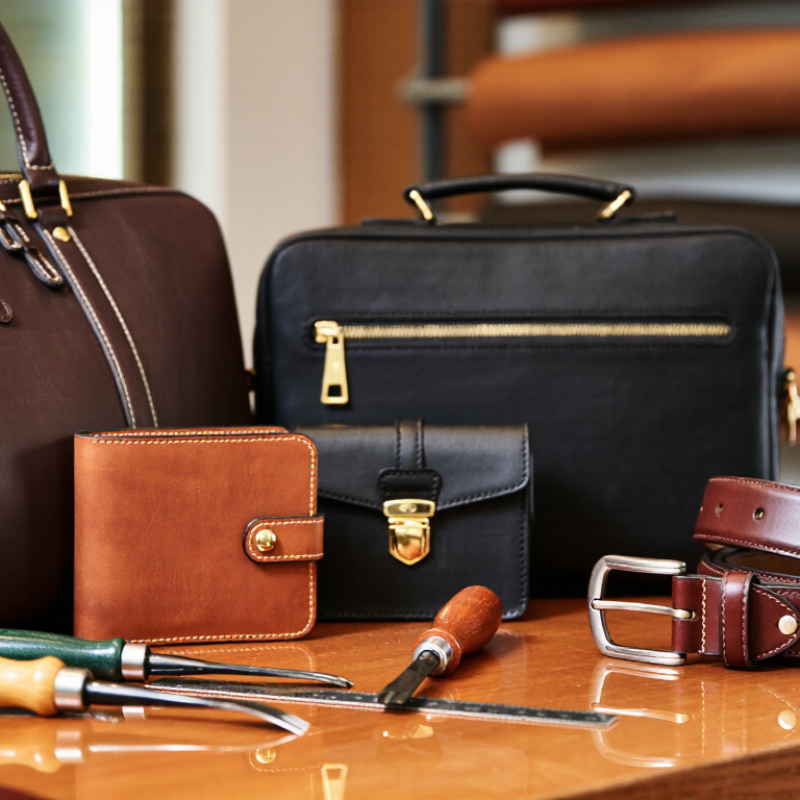
Leather goods suppliers serve buyers across luggage, handbags, wallets, cases, and small travel accessories. Under HS 4202, classification covers many containers designed for carrying personal items. Examples include suitcases, briefcases, school satchels, handbags, wallets, spectacle cases, camera cases, and jewelry boxes. The product’s function matters more than its appearance.
Materials can change the tariff description and commercial value. Common options include full-grain leather, corrected-grain leather, suede, composition leather, coated textile, plastic, and paperboard. Full-grain leather may show natural scars and uneven pores. That is not automatically a defect. A polished sample can hide construction problems, though. Buyers should inspect edge paint, stitching density, zipper alignment, lining strength, and hardware corrosion after repeated handling.
Reliable sourcing requires more than comparing catalogue prices. Ask suppliers for material specifications, product dimensions, packing details, production samples, and test records. Confirm whether “leather” means animal hide, split leather, or composition leather. Request clear photographs of cut edges. Small details matter. HS 4202 classification can depend on construction, outer surface material, and the importing country’s tariff interpretation. Suppliers should provide consistent commercial invoices and packing lists, but buyers should verify final codes with a qualified customs professional. One mistake can affect duty, delivery time, and landed cost. Supplier audits, sample approvals, and written inspection standards make global purchasing more dependable, although no checklist removes every risk.
For global buyers, supplier selection should begin with market evidence, not a polished catalog. Grand View Research reports that the global leather goods market reached about USD 468.49 billion in 2023. It projects a 6.9% CAGR from 2024 to 2030. These figures indicate strong expansion, but they are not purchase guarantees. Market estimates can shift with exchange rates, regional demand, and changing material preferences.
The growth signal helps buyers compare supplier capacity with realistic demand. A capable supplier should show consistent stitching, edge finishing, hardware strength, and measurement control. Ask for production samples, inspection records, and traceable material documentation. A factory visit can reveal more than a video call. Look closely at cutting tables, humidity control, packing areas, and rejected pieces. Small details matter.
Still, CAGR can hide uneven performance between product categories and countries. Bags, footwear, travel goods, and accessories may not grow at the same pace. I would treat the 6.9% rate as a planning reference, not a promise. Buyers should request updated quotations, minimum order quantities, lead times, and defect policies before signing. Supplier rankings also need caution. The largest producer is not always the most responsive partner. A smaller workshop may offer better sampling, yet struggle during seasonal surges.
Top Leather Goods Suppliers for Global Buyers
UN Comtrade HS 4202 data offers a practical view of the global luggage and leather goods trade. The category includes handbags, wallets, travel cases, and similar containers. It also covers products made from textile, plastic, and other materials. This distinction matters. HS 4202 is not a leather-only code.
In 2023, China remained the leading exporter by value, according to UN Comtrade records. Italy, France, Germany, and the Netherlands also ranked among major exporting countries. ITC Trade Map shows strong export activity across European manufacturing hubs, especially for higher-value fashion accessories and travel goods. China provides scale, broad product capacity, and competitive production networks. Italy is often associated with skilled finishing and material quality. However, country-level data cannot confirm factory quality. It only shows trade performance.
Tips: Compare suppliers using HS 4202 exports, factory audits, material certificates, and sample inspections. Ask whether reported goods are genuine leather or mixed-material products. Check shipment consistency across several years, not one strong season. WTO trade statistics and national customs records can help verify unusual figures. Small suppliers may offer excellent craftsmanship, but their export data can be limited. That is easy to overlook. Buyers should also review lead times, defect rates, packaging strength, and responsible sourcing documents before placing large orders.
A useful supplier ranking starts with evidence, not polished catalog photos. For leather goods, I compare MOQ, monthly capacity, certifications, and verified defect rates across at least three production cycles. Entry-level workshops often accept 100 to 300 pieces per style. Larger factories may require 500 to 1,000. MOQ alone can mislead. A low minimum may hide higher unit costs or inconsistent material sourcing. Capacity should be checked against machines, trained operators, and peak-season output. I ask for production records, not estimates. A practical benchmark is 10,000 to 30,000 finished pieces monthly for a stable mid-sized facility.
Certification claims need scope and dates. Confirm whether audits cover the factory, subcontractors, materials, or only an office. Relevant evidence can include quality-management certification, environmental controls, and restricted-substance testing. Certificates are not proof of daily discipline. During sample inspections, I track stitching tension, edge paint, hardware alignment, odor, and color variation. A defect rate below 2% is strong for repeat production; 2% to 5% deserves corrective action. Above 5% usually signals weak process control. These figures need a shared inspection standard and a defined sample size. I have seen attractive samples fail bulk checks. That remains a costly reminder. Rank suppliers by repeatable evidence, responsive corrective action, and honest capacity limits, not promises made during one meeting.
Anonymous supplier ranking based on MOQ, production capacity, certification coverage, and defect-rate benchmarks
| Supplier Profile | MOQ units/order |
Monthly Capacity pieces |
Certification Coverage | Defect Rate AQL inspection |
|---|---|---|---|---|
| Specialist Workshop | 50 | 12,000 | ISO 9001 and social compliance documentation | 2.0% |
| Established OEM | 200 | 40,000 | ISO 9001, ISO 14001, social compliance | 1.2% |
| Export Factory | 500 | 100,000 | ISO 9001, ISO 14001, social compliance, LWG-related sourcing evidence | 0.8% |
| Compliance-Led Factory | 300 | 70,000 | ISO 9001, ISO 14001, SA8000, social compliance, environmental documentation | 0.6% |
The chart converts each procurement indicator into a 0–100 benchmark index for easier comparison. Higher capacity, broader certification coverage, and lower defect rates improve the index, while lower MOQ improves flexibility for smaller buyers. Actual requirements vary by product complexity, leather type, inspection standard, and order season.
Global leather buyers need more than a polished sample and a low quotation. Supplier due diligence should begin with LWG certification, but certification alone is not complete proof. Request the certificate number, holder name, site address, scope, and expiry date. Check whether it covers the actual tannery, not only a trading office. Ask for recent audit findings and corrective-action records. Small details matter.
Pricing should be examined line by line. Compare leather grade, thickness, finish, testing, packaging, tooling, and minimum order quantity. A cheaper offer may exclude laboratory tests or realistic waste allowances. Request a sample cost sheet and confirm currency, payment stages, and price validity. I once treated a low price as strong evidence of efficiency. That assumption was too simple. Material consistency later mattered more than a minor saving.
Factory audits should include production capacity, traceability, chemical management, worker safety, and subcontracting controls. Visit the site when possible, or use an independent auditor with clear credentials. Photographs help, but they cannot replace records and interviews. Incoterms also need careful review. FOB may leave the buyer arranging main transport, while CIF includes freight but not every destination charge. DDP can simplify delivery, yet tax and import responsibilities require professional verification. Put insurance, inspection rights, delivery dates, and claims procedures in writing. Ask difficult questions early. Mistakes become expensive at the port.
HS 4202 covers handbags, wallets, travel cases, and similar containers. Materials may include leather, textile, plastic, or mixed components. It is not a leather-only category.
China led exports by value in 2023. Italy, France, Germany, and the Netherlands also showed strong export activity. Country rankings reflect trade value, not factory quality.
No. Export records show shipment performance, not stitching quality or workplace discipline. Compare several years of data. One strong season can mislead.
Compare MOQ, monthly capacity, certifications, defect rates, lead times, and corrective responses. Request production records instead of relying on estimates. Evidence matters.
Smaller workshops may accept 100 to 300 pieces per style. Larger factories may require 500 to 1,000 pieces. A low MOQ can hide higher unit costs.
Check machine numbers, trained operators, and peak-season output. Ask for records covering several production cycles. A stable mid-sized facility may produce 10,000 to 30,000 pieces monthly.
Check stitching tension, edge paint, hardware alignment, odor, and color variation. Inspect bags under normal lighting. Attractive samples can still fail bulk checks.
Below 2% is strong for repeat production. Between 2% and 5% requires corrective action. Above 5% often indicates weak process control. These figures need a defined sample size.
No. Confirm their scope, issue date, and covered locations. Check whether subcontractors and materials are included. Certificates do not prove daily discipline.
Review material documents, sample results, packaging strength, lead times, defect rates, and responsible sourcing records. Smaller suppliers may offer excellent craftsmanship. Their export data may remain limited. No ranking is perfect.
This guide provides a practical overview of the global Leather Goods supply market, beginning with the main product categories, commonly used materials, and the trade scope covered by HS code 4202. It explains how wallets, bags, cases, travel products, and related accessories are classified, while also outlining key market indicators such as estimated market size, historical growth, and projected CAGR. Export data by leading countries is used to illustrate major supplier regions and changing trade patterns.
The article then presents a supplier evaluation framework based on minimum order quantities, production capacity, certification status, quality systems, and acceptable defect rates. For effective due diligence, buyers should verify material consistency, request production samples, review audit records, confirm responsible sourcing practices, and compare total landed costs rather than unit prices alone. Clear payment terms, inspection procedures, lead times, and suitable Incoterms are also essential for reducing risk and building reliable international supply relationships.
