
Wholesale buyers are entering a practical, crowded Leather Card Wallet market. Grand View Research valued the global leather goods market at approximately USD 468 billion in 2023. Its report also projects continued growth through 2030. However, the research does not isolate card wallets. That limitation matters when forecasting bulk demand.
Small details often decide repeat orders. Buyers should inspect leather thickness, edge paint, stitching density, lining quality, and pocket recovery. A wallet may look elegant in photographs but feel rigid in a customer’s hand. Test samples under realistic conditions. Insert several cards. Slide them out repeatedly. Check whether the surface scratches too easily.
Craft matters.
Leathercraft educator Nigel Armitage states, “Good leatherwork begins with understanding the material.” His principle is highly relevant to wholesale selection. Full-grain leather can develop a richer patina, while corrected-grain leather often offers more consistent appearance and pricing. Neither option is automatically best. The right choice depends on target customers, retail positioning, and expected use.
Industry reports from Grand View Research and Fortune Business Insights point toward sustained interest in premium accessories, personalization, and durable everyday products. Yet market estimates vary because analysts classify wallets differently. Buyers should remain cautious. A projected growth rate is not a guaranteed order volume.
This guide evaluates seven Leather Card Wallet options for wholesale buyers. It considers construction, capacity, packaging, customization potential, supplier consistency, and visible quality. Some products may appear nearly perfect. They are not. Manufacturing variation still happens. Strong sourcing decisions leave room for inspection, negotiation, and honest reassessment.
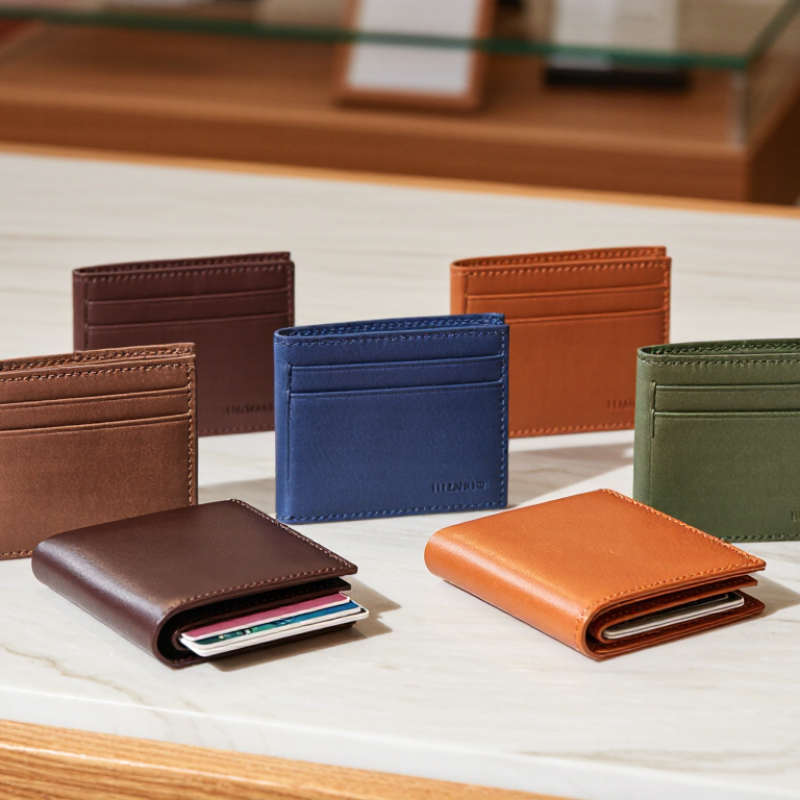
7 Best Leather Card Wallets for Wholesale Buyers
What Makes a Leather Card Wallet Suitable for Wholesale
Wholesale suitability starts with repeatable quality, not a glossy sample. Grand View Research valued the global leather goods market at approximately $242.85 billion in 2022. It projected a 6.9% compound annual growth rate through 2030. These figures indicate opportunity, but they do not guarantee sales for every wallet style.
A wholesale-ready card wallet should use consistent leather thickness, clean edge finishing, and secure stitching. Ask for leather grading, material composition, colorfastness results, and production tolerances. A practical sample should survive repeated loading, pocket friction, and light moisture exposure. Check whether card slots stretch evenly after 50 to 100 insertions. Small defects become expensive when multiplied across 1,000 units.
Capacity also matters. A slim design may fit four to six standard cards without becoming bulky. However, real customers may carry folded receipts or thicker identification cards. I have seen buyers approve attractive samples that failed during normal daily use. That mistake is easy to repeat. Request pre-production samples, carton dimensions, labeling options, and clear replacement terms. Allied Market Research estimated the leather goods market at $394.7 billion in 2022, while forecasting $624.08 billion by 2032. The differing estimates reflect different research methods, so buyers should test products rather than trust market size alone.
| Wallet Style | Recommended Leather | Typical Dimensions | Card Capacity | Main Construction | RFID Option | Typical Wholesale Range (USD / Unit) |
Wholesale Advantages |
|---|---|---|---|---|---|---|---|
| Slim Front-Pocket Card Holder | Full-grain or corrected-grain cowhide | Approximately 10.0 × 6.5 × 0.6 cm | 2–6 cards | Two exterior card slots with a central sleeve | Optional | $3.50–$7.00 | Low material usage, compact shipping size, easy entry-level pricing, and strong suitability for promotional or everyday-use collections. |
| Bifold Leather Card Wallet | Full-grain, top-grain, or vegetable-tanned cowhide | Approximately 10.5 × 7.5 × 1.0 cm when closed | 4–8 cards | Folded center construction with two to four internal slots | Optional | $5.00–$10.00 | Familiar format, practical organization, broad customer appeal, and good space for custom embossing or private-label packaging. |
| Zipper Card Wallet | Top-grain or corrected-grain cowhide with textile lining | Approximately 11.0 × 8.0 × 1.5 cm | 6–12 cards plus folded notes | Three-sided or top zipper with gusseted compartment | Optional | $6.00–$12.00 | Secure closure, higher perceived value, and additional storage for coins, keys, receipts, or small personal items. |
| Card-and-Cash Sleeve | Full-grain or vegetable-tanned leather | Approximately 10.5 × 7.0 × 0.8 cm | 4–8 cards plus folded bills | Card slots on the outside with a central cash compartment | Optional | $4.50–$9.00 | Combines card and cash storage without the bulk of a traditional wallet; suitable for minimalist and travel-oriented product lines. |
| Vertical Card Wallet | Full-grain or top-grain cowhide | Approximately 9.5 × 7.0 × 1.0 cm | 5–10 cards | Vertical slot layout with a central pocket | Optional | $5.00–$10.50 | Distinctive orientation, efficient use of leather panels, and convenient access for customers who prefer vertical card storage. |
| Expandable Gusset Card Wallet | Top-grain or full-grain cowhide | Approximately 10.5 × 7.5 × 1.3 cm | 8–15 cards | Accordion gussets with multiple organized compartments | Optional | $7.00–$14.00 | Higher capacity, clear internal organization, and stronger suitability for customers who carry multiple payment, identification, or membership cards. |
| Snap-Closure Card Wallet | Full-grain or vegetable-tanned cowhide | Approximately 10.5 × 7.0 × 1.2 cm | 5–10 cards plus folded notes | Fold-over flap secured with a metal snap fastener | Optional | $5.50–$11.00 | Protective closure, distinctive appearance, simple assembly, and good compatibility with gift sets and seasonal retail programs. |
Wholesale ranges are indicative benchmarks for unbranded leather card wallets in standard colors and basic packaging. Final pricing varies with leather grade, thickness, hardware, lining, RFID materials, customization, packaging, order quantity, and shipping terms.
Ask for leather grade, thickness, finish, and processing details. Natural variation may indicate full-grain leather. Uniform texture is not always better. Inspect the cut edge for dense fibers and loose layers. A strong chemical smell deserves questions.
Check even stitches, folded edges, lining, corners, and pocket openings. Edge paint should feel smooth. Avoid bubbles, gaps, and rough surfaces. Photographs are not enough. Request physical samples.
Insert a card into every slot. It should slide in easily and stay secure when inverted. Test the wallet at its stated capacity. Then leave room for daily movement. Overfilled pockets can stretch leather.
Compare slim sleeves, bifolds, zip wallets, ID holders, and money-clip designs. Coin-pocket and multi-slot models serve different customers. A slim sleeve may use less leather but support a lower selling price. Choose based on customer habits, not appearance alone.
Request matching leather grade, lining, hardware, packaging, and customization. Otherwise, the prices are not truly comparable. Include freight, duties, inspection, payment fees, and expected defects. Small cost differences can matter.
Ask about standard and customized quantities separately. A supplier may accept 100 standard pieces but require 500 customized pieces. Confirm mixed colors and size-based quantities. Get sample fees, lead time, defect allowances, and replacement terms in writing.
Subtract landed cost from wholesale price to find gross profit. Divide gross profit by wholesale price to calculate margin. Include storage costs and slow-moving colors. My early estimates were too optimistic. The calculation is useful, but incomplete.
Request samples from different production batches. Compare dimensions, lining, logo placement, packaging, and material feel. Ask about monthly output and quality procedures. Check scratches, loose threads, uneven dye, and weak closures. Request carton tests and moisture protection.
Poor packaging can press wallet edges and damage their shape. Measure the wallet empty and loaded. Small size differences affect packaging and freight. Keep inspection records and dispatch photographs. No checklist is perfect.
Choosing the right Leather Card Wallet for wholesale requires more than selecting an attractive design. Buyers should evaluate leather quality, grain consistency, edge finishing, stitching strength, lining, hardware, and practical card capacity. Popular wholesale styles may include slim two-slot wallets, multi-card bifold designs, zippered holders, transparent ID wallets, minimalist front-pocket models, vertical card cases, and coin-pocket versions. Each style serves different customer preferences and price points, so product selection should balance function, appearance, durability, and market demand.
Wholesale buyers should also compare supplier pricing, minimum order quantities, customization options, production timelines, packaging, and expected profit margins. A reliable supplier should provide clear material specifications, consistent craftsmanship, samples for inspection, and responsive communication. Reviewing quality-control procedures and negotiating reasonable order terms can help reduce risk while supporting long-term cooperation. By comparing products and suppliers systematically, buyers can choose a Leather Card Wallet collection that offers dependable quality, flexible customization, competitive pricing, and strong resale potential.
